
On 3 February 2026, software stocks lost around 285 billion dollars in value in a single day. The trigger was a handful of add-ons that Anthropic had released for its assistant Claude, among them one for legal departments. Thomson Reuters fell almost 16 percent that day, LegalZoom just under 20, HubSpot just over 10. A trader at the investment bank Jefferies gave it the name that has been doing the rounds ever since: SaaSpocalypse, the end of the world for rented software.
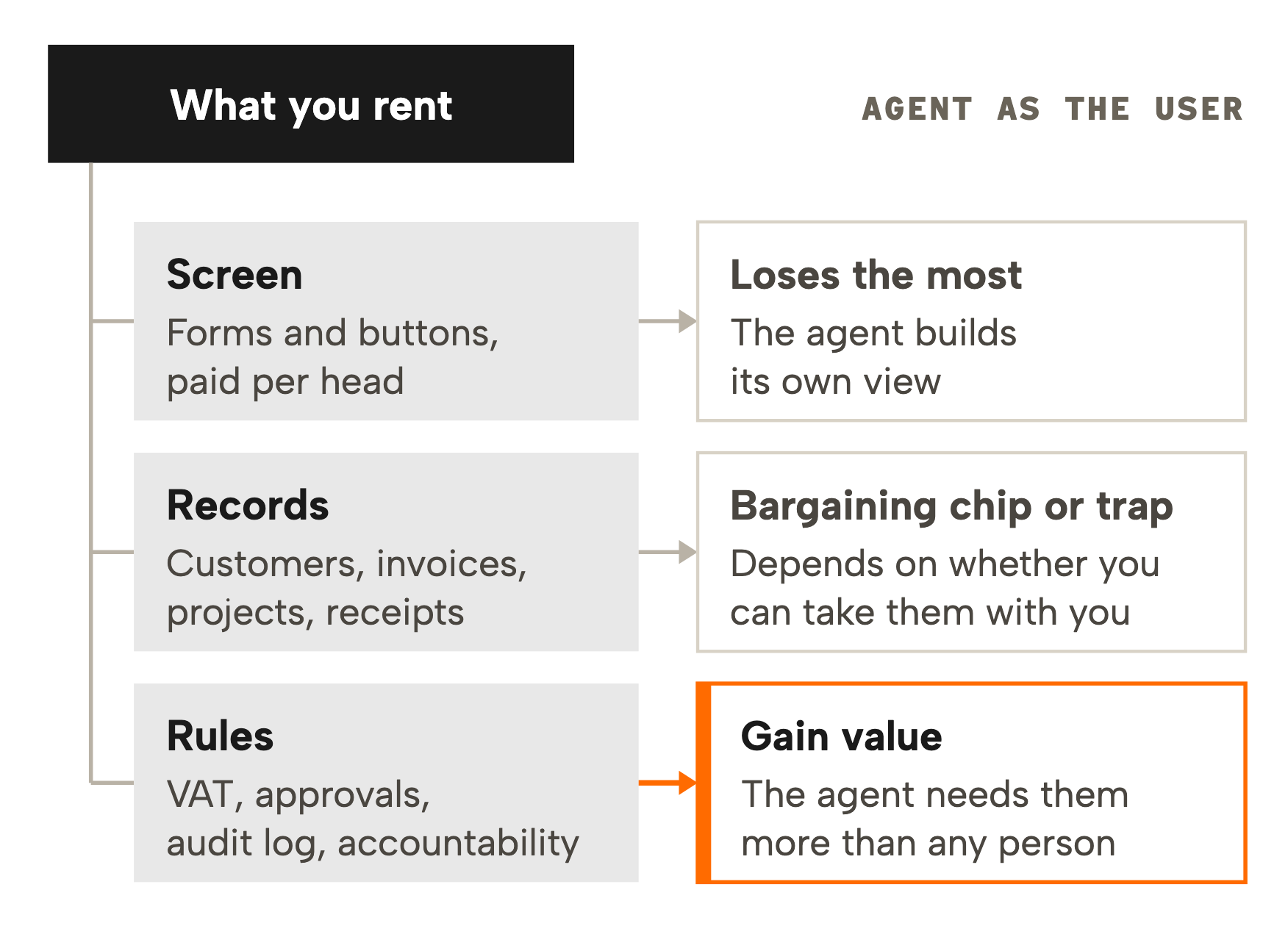
When you rent software, you pay for three things at once: the screen, the records and the rules. An AI agent does not need the screen, but it needs the records and, even more, the rules. Before your next contract renewal, ask whether an agent can work with the software without anyone clicking.
It was not quite that dramatic. Prices were already falling before that day, the low only came in April, and a good part has recovered since. But the question investors asked that day remains, and it concerns you as a customer more than the shareholders: what are you actually paying for when you rent software? And how much of it does an AI agent still need?
What you rent when you rent software
You used to buy software, install it and run it yourself. With the rental model you outsourced three things at once, even though the invoice shows only one line.
The screen. Forms and buttons, the screens your people work with. You pay per head for it, because every head needs a screen.
The records. Your customers, invoices, projects and receipts. The vendor keeps the database for you, backs it up and keeps it available.
The rules. What counts as a valid invoice, how VAT is calculated, who may approve what, and the log of who changed what and when. That is the expertise built into the software, along with the responsibility for it.
Microsoft CEO Satya Nadella said on a podcast at the end of 2024 that business applications are essentially databases with a lot of business logic on top, and that this logic is moving to agents. I think that is half right. An agent does not read forms, so it does not need the screen. It very much needs the records. And it needs the rules more urgently than any human, because it makes mistakes faster than any human.
So the three parts do not lose the same amount of value. The screen loses the most. An agent builds the view it needs at that moment, and the human looks at the result instead of the form. The records become a commodity if you can take them with you easily, and a trap if you cannot. The rules gain value. Your accounting software knows what a Swiss VAT return looks like. An agent can look that up, but it cannot take responsibility for it.
In July, Gartner estimated that by 2030 around a fifth of spending on rented business software is at stake, because agents make the software invisible. The analyst responsible speaks of a transformation. On that, I agree with him.
Our own case: software that waits for clicks
A design studio I support runs its quotes, projects and invoices in rented project software. The software can do a lot, from electronic signatures to creating a project automatically once a quote is accepted. We went through 100 of the studio's quotes. Not a single one of these features had been used.
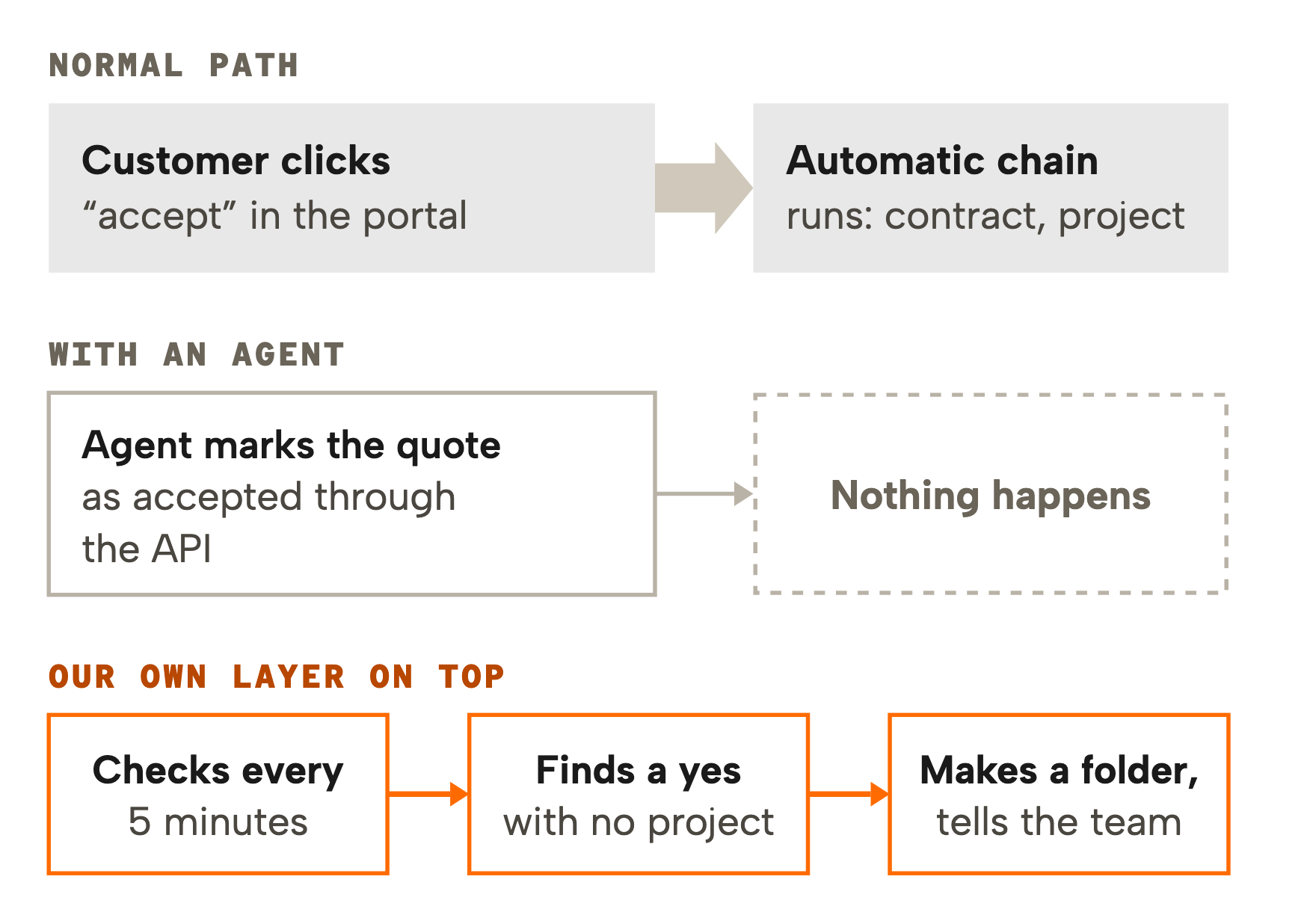
The surprise came when we put an agent to work on it. When the agent marks a quote as accepted through the software's interface, nothing happens. The automatic chain only starts when the customer clicks the button in the portal themselves. The software is built for people who click. An agent that does the same thing does not exist for it.
We still did not replace the software. The team keeps working in it, and the data stays there. On top of it there is now a layer of our own that checks every five minutes whether an accepted quote is sitting somewhere without a project. When it finds one, it creates the project folder and tells the team. The rented software holds the records, and the work happens in the layer above. I expect this shift at most companies that use agents seriously.
I also got something wrong along the way. At first I was convinced the vendor was half locking its interface, because many requests were being rejected. A large share of them came from wrong addresses within the interface, in other words from me. Before you accuse a vendor of locking you out, it pays to take a second look.
For our own customer directory we decided differently and did not rent one. We built one that was designed for agents from the start: every change goes through a single door, and every change lands in the log with before, after and author. I would not recommend that to a company with 50 people. For us it was the quickest way to find out what software for agents has to be able to do.
Vendors face an uncomfortable choice
That puts vendors in a bind. If they open their records to their customers' agents, they become a pipe that can be swapped out. If they lock them away, they annoy their customers and invite the competition in. The big ones are currently trying both at once.
Salesforce changed the rules for Slack in May 2025. Since then, outside programs may no longer pull data in bulk, create permanent copies or use the data for language models. Programs outside Slack's own marketplace face a brake: one request per minute, at most 15 messages. In February 2026 Slack then released its own search interface for agents. They may ask, but they may not take anything with them. So Slack is opening up, but on its own terms.
SAP has gone further. According to reports on its new interface policy from April 2026, agents that plan on their own and carry out calls may no longer use SAP's interfaces, except through SAP's own tools. The German-speaking SAP user group DSAG has criticised this publicly. ServiceNow lets outside agents in and counts every single call against a quota the customer pays for. In April HubSpot released open access for agents, reading and writing, with the same rights the user in question already has.
Prices are shifting too. Salesforce charges ten US cents per agent action. Intercom charges just under a dollar once its agent has resolved a customer enquiry. Microsoft, on the other hand, still sells the management of its agents per user, for 15 dollars a month, no matter how many agents someone has. Who pays for what when one agent does the work of five people? Nobody has an answer to that yet that holds up.
The key card is not yours
Imagine you hire someone, and the landlord of your office building decides whether the new person gets a key card for the archive, which rooms they may enter and whether every door they open costs extra. That is how it works today with agents and rented software. You hire the agent. The vendor issues the key card.
The picture has a weak point. A key card only knows open or closed. An agent needs finer levels: read yes, write only here, delete never, and a log of everything. Good rented software will sell these levels in future. Its main job will then be to decide who may do what with your data.
That is why I do not believe in the end of the world. An agent rebuilds a screen in minutes. It does not rebuild an accounting system that someone has to answer for to the tax authorities.
What this means for your next contract
Most companies ask about features and the price per user when they buy software. Both matter less once an agent is working alongside. I would ask four other questions.
Can an agent reach the data, with its own identity rather than your password?
What may it do: read, write, and where exactly? Do the same rights apply to it as to a person in the same role?
Is there a log of what the agent changed, so you can trace it and undo it?
What does it cost when an agent works instead of a person, and can you get everything back out?
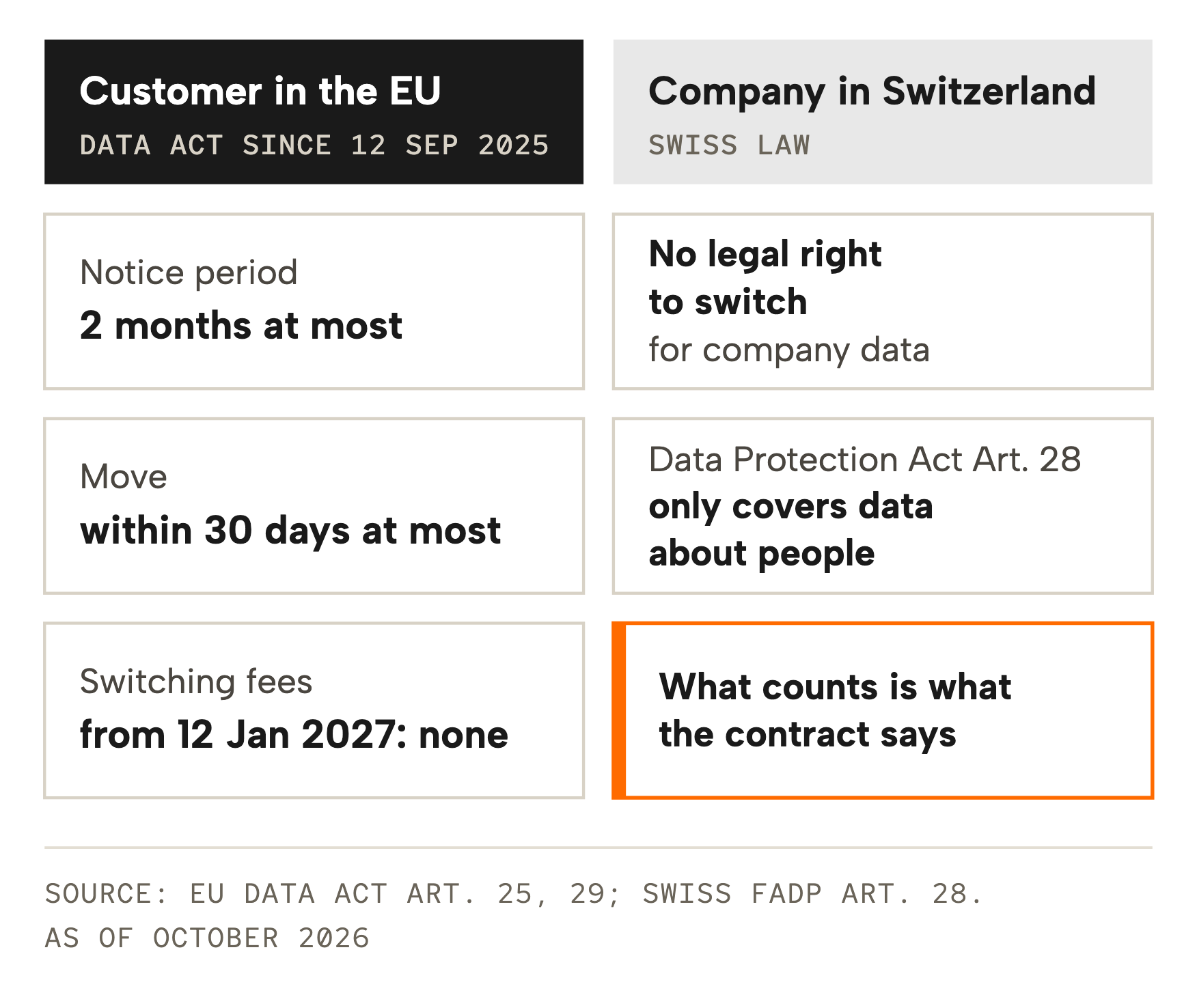
On the last question, Swiss companies are worse off than their neighbours. In the EU, the Data Act has applied since September 2025. If you rent software there, you may switch with at most two months' notice, the move has to be done within 30 days, and from January 2027 the vendor may no longer charge for it. A company in Switzerland gets nothing from this directly, no matter where its vendor is based, because the law protects customers in the EU. The Swiss Data Protection Act gives a right to have data handed over only for data about people, not for your company's data. Anything else you may take with you is in your contract or nowhere.
Where this argument wobbles
The argument has blind spots, and I do not want to hide them.
Most SMEs do not yet have an agent that works on its own in their systems. Back in 2025, Gartner predicted that more than 40 percent of agent projects will be cancelled by the end of 2027. For many companies this is a question for 2027, not for this autumn.
Locking things down also has a good reason. An agent with write access is a new point of attack. A vendor that slows down outside access is also protecting your data.
The screen does not disappear completely either. Someone has to check and approve, and that happens on a screen. It becomes smaller and different, more approving than entering.
Dependence has its uses too. Software that does everything from one source is often cheaper than five connections someone has to maintain. Maintaining those connections takes time every month, and someone in your company has to plan for it.
The next contract renewal
Our own model is headed by one sentence: the model is replaceable, the company layer stays. The same will apply to rented software. Software will become more replaceable than its vendors would like. What remains are your records and your rules, provided you can get at both.
That is why I would not start the next contract renewal by asking about new features, but with this question: can my agent work with it without anyone clicking?
I am curious how this looks for you: which of your programs could an agent operate today, and for which would someone still have to sit next to it?
Sources
- Stock drop on 03.02.2026 and the term "SaaSpocalypse" (Jeffrey Favuzza, Jefferies, via Bloomberg). deeplearning.ai; morningstar.com; daily closing prices from Yahoo Finance (IGV, TRI, LZ, HUBS).
- Recovery since the low of 10.04.2026. cnbc.com
- Slack API terms, 29.05.2025. hunton.com; rate limits: docs.slack.dev
- SAP API policy 2026 and criticism from DSAG. Section 2.2.2 quoted consistently, the policy text itself not retrievable. computerwoche.de; cio.com
- ServiceNow Action Fabric, May 2026. One call = one "Assist", price per Assist set by contract. servicenow.com
- HubSpot remote MCP server, generally available 13.04.2026. developers.hubspot.com
- Slack Real-Time Search API and MCP server, generally available 17.02.2026. docs.slack.dev
- Salesforce Flex Credits, since 15.05.2025, 20 credits = USD 0.10 per action. help.salesforce.com. Intercom Fin, USD 0.99 per outcome. intercom.com. Microsoft Agent 365, USD 15 per user per month, generally available 01.05.2026. samexpert.com
- Gartner, press release 01.07.2026 on "agentic arbitrage" (USD 234 billion cumulative by 2030, around 20 percent of SaaS spending on business applications). channeldive.com
- Gartner, press release 25.06.2025. gartner.com
- Satya Nadella on the BG2 podcast, 12.12.2024 (Brad Gerstner, Bill Gurley).
- EU Data Act, Regulation (EU) 2023/2854, Art. 1(3)(f), Art. 25, Art. 29; applicable since 12.09.2025. eu-data-act.com
- Swiss Federal Act on Data Protection (FADP), Art. 28, applies only to natural persons. onlinekommentar.ch