
The question I hear most about AI is: "What is the right use case for us?" It usually arrives with a list. Summarising minutes, writing quotes, answering emails, something with agents. The list comes from a webinar, a vendor or LinkedIn, and it has little to do with the company asking.
An AI use case either lowers costs or brings in revenue. Otherwise it is a hobby. To judge that, you need to know your costs by activity rather than by account, and the one bottleneck that decides how much the company sells. Time saved only turns into money when someone redesigns the workflow.
Look at what Swiss SMEs actually use AI for today. This year AXA and the research institute Sotomo surveyed 336 SMEs. At the top are translation (47 percent) and correspondence (42 percent). Both are useful, and I do both every day. They just never show up in the income statement. Almost half of the companies expect AI to save time without any change in staffing. AXA names the open question itself: how SMEs turn many small efficiency gains into real added value.
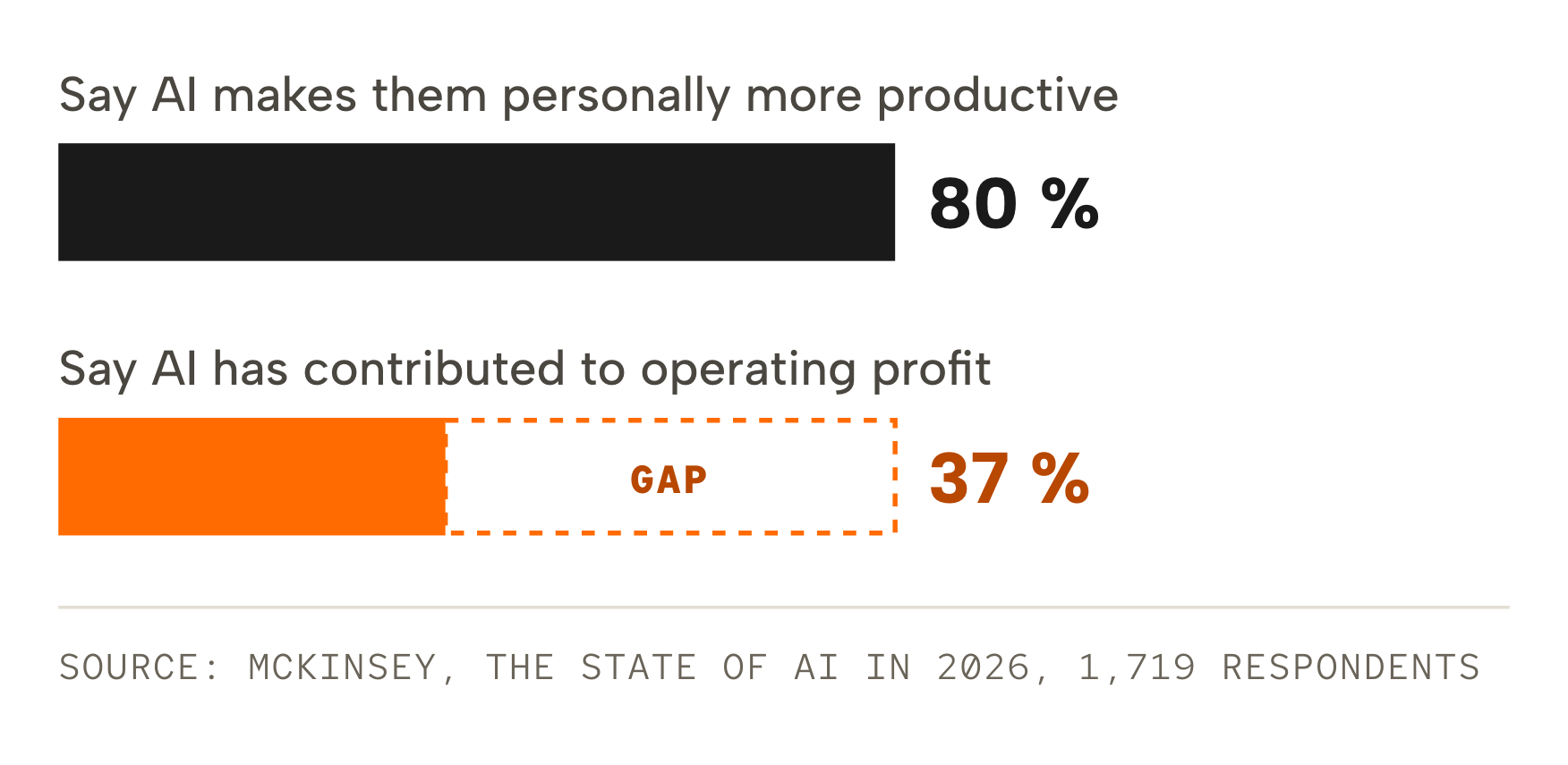
Large companies look similar. In early summer McKinsey surveyed just over 1,700 executives worldwide. 80 percent say AI makes them personally more productive. 37 percent say AI has contributed anything at all to their company's operating profit, the same share as the year before.
I think the problem is less the technology than the question. If you start with "What can AI do?", you end up with what AI is good at. If you start with "How do we make money, and where do we lose it?", you end up with what helps the business, and the two rarely overlap.
A company lives on two numbers
Let's be honest, this is first-semester business administration. A company creates value for someone, and that someone pays for it. On the other side, it costs something to make that value, sell it and deliver it. What is left in between is the reason the company exists.
That gives every AI use case a hard rule. It lowers costs, or it brings in more revenue, or it is a hobby. Hobbies are allowed. Nobody should mistake them for a strategy.
That sounds trivial. Many companies still fail right here, because they know both sides of their own numbers only roughly. What goes on salaries and rent each year is in every set of accounts. What it costs to write a quote or win a new customer, hardly anyone knows. I am no exception. A quote costs me one to four hours, depending on the scope. What that adds up to in francs over a year, I have never worked out. Accounting shows costs by account, and AI works in workflows. As long as that translation is missing, nobody can say where AI moves anything.
Four lenses from business school
Nobody has to invent anything new for this translation. The tools have been in MBA textbooks for decades. Four of them fit AI surprisingly well.
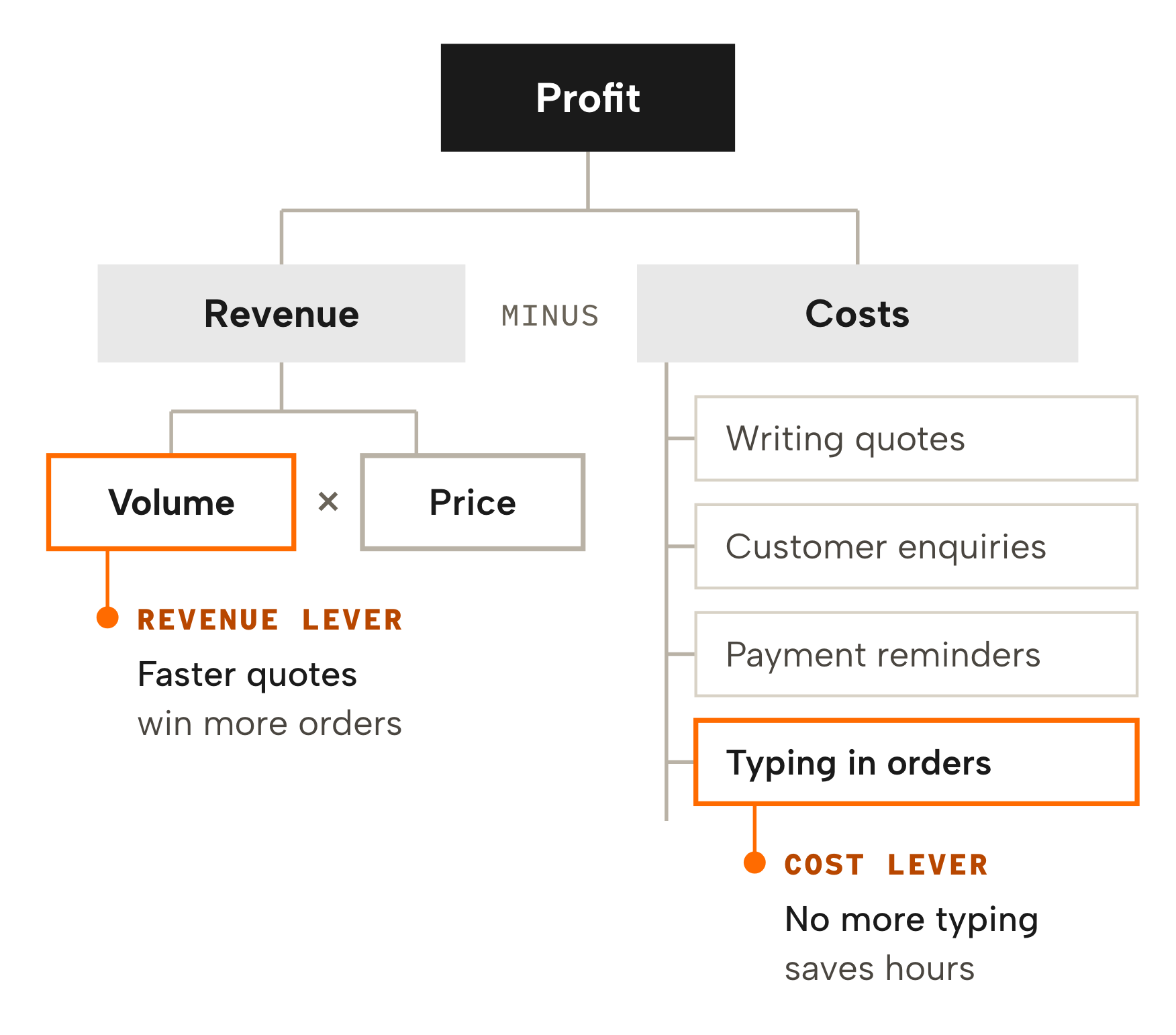
The profit tree. Profit is revenue minus costs, revenue is volume times price, costs break down into blocks. At the chemicals group DuPont, managers split return into branches like this more than a hundred years ago, and every business school still teaches it. For AI this means: every use case has to hang on a branch, and you have to be able to say which one and by how much. If you cannot, you have a pilot, not a use case.
The value chain. In 1985 Michael Porter split every company into primary and support activities: receiving materials, making, shipping, selling, servicing, and behind them management and finance, people, technology, purchasing. Walk your own chain once, step by step, and you see where work piles up and where customers get lost. You end up with a map of the whole company. The first vendor on the phone only shows you his slice of it.
Costs by activity, not by account. In 2004 Robert Kaplan and Steven Anderson described a lean method for this: how many minutes an activity takes, how often it happens, what an hour costs. The result might show that typing orders from emails and PDFs eats a full working day every week, spread across several people, and that nobody noticed because it sits on no account. Those are the places where AI earns its keep first: large blocks of hours spent on recurring head work.
The bottleneck. In 1984 Eliyahu Goldratt wrote down something production managers know by heart and AI sales pitches rarely mention. A company delivers as much as its narrowest point allows. If quotes sit with two engineers who also run projects, the company sells as much as those two people can quote. Time you save elsewhere just sits there. I think this fourth lens matters most, because it explains a puzzle many economists are writing about right now.
Time saved is not money saved
Two economists in Denmark linked surveys to official wage and working-time records for 25,000 employees in 7,000 workplaces. Two years after ChatGPT launched, they find no measurable effect on earnings or hours worked. Average time saved is around 3 percent. At the same time, a study by researchers from Stanford and MIT with more than 5,000 customer-support agents shows that AI lets them resolve 14 percent more cases per hour, and 34 percent more for new hires.
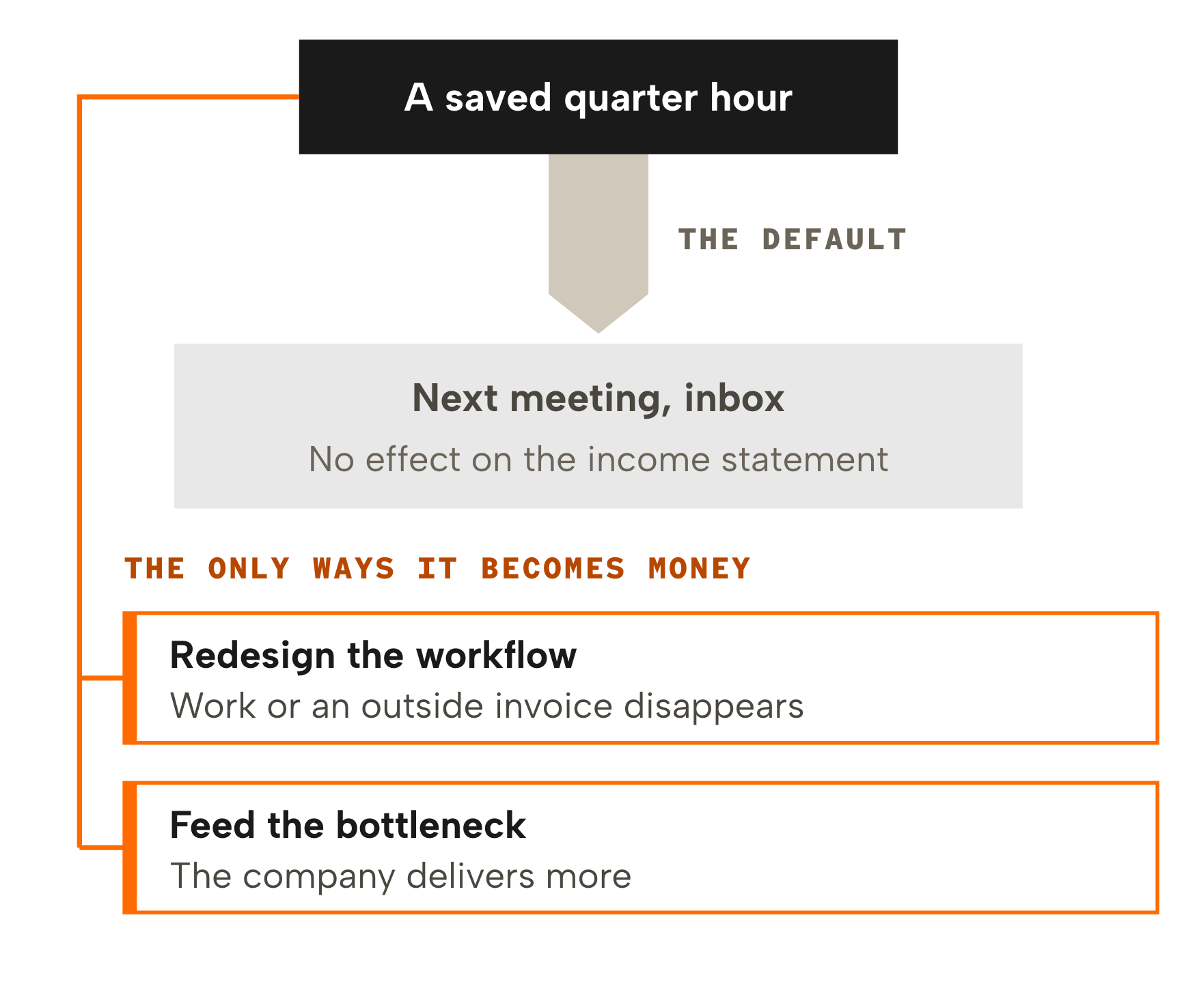
Both are true. People get faster, and the company does not notice. The saved quarter of an hour spreads across the day and ends up in the next meeting or the inbox. It only becomes money when someone redesigns the workflow so that work disappears or an outside contract is no longer needed, or when the freed-up time goes straight into the bottleneck. McKinsey finds the same link from the other side: almost three quarters of companies with a clear profit effect have fundamentally redesigned their workflows because of AI. Among everyone else it is about a quarter.
On the cost side: start with the supplier invoice
The most honest saving is often on someone else's invoice. Last year a team at MIT published a widely quoted and methodologically thin report, but one finding in it stands out: the measurable savings came mainly from lower external spend, for agencies and outsourced admin work, for example. The companies hardly cut staff to get them.
For an SME that is a useful first question: what do we pay someone outside for today because we cannot manage it in-house? For many it is copy and translation, for some it is receipt capture. There the saving sits on an invoice and does not have to be extrapolated from estimated hours.
Next come the large blocks of hours that activity-based costing makes visible, typically order entry, quote preparation and payment reminders.
On the revenue side: where customers wait
Here the effect is bigger and harder to measure. This September BCG surveyed more than 1,300 executives. Almost half of the companies now get real value from AI. The leaders grow revenue more than twice as fast as the laggards. What sets them apart, according to BCG, is that they rebuilt entire workflows end to end in their most important areas. MIT, on the other hand, finds the fastest returns in the back office. I think both are right. The back office holds the money you can prove today, and the core business holds the larger amount that only comes after a redesign. Both studies, by the way, mostly survey large companies.
The revenue question is: where do we lose customers or orders today because we are too slow or too expensive? If your quote reaches the customer after two days instead of two weeks, you win different orders. If you notice a customer is about to leave before they cancel, you might keep them. Both hang on the profit tree, just on a different branch than costs.
What this lens misses
The cost-and-revenue lens has blind spots, and I do not want to hide them. Risk and quality get too little weight, because an avoided mistake appears on no invoice. Tied-up capital is missing too: if you invoice faster, the money is in your account sooner without selling more. Savings that all your competitors soon have as well end up in prices sooner or later. The fourth blind spot is the one I underestimate most myself: what your people already do with AI on their own, often in places that appear on no process map.
So I would widen the lens and point it at risk, cash and the quiet everyday AI use inside the business as well.
Where I would start
With last year's income statement, before any tool is on the table. Three questions are enough to begin: where are the biggest cost blocks, by activity rather than by account? Where do we pay third parties for work that repeats? And where is the one bottleneck that decides how much we can sell or deliver?
Once you have answered these three questions, you no longer need a list from a webinar. The use cases are there, with a number next to them.
I am curious how this looks for you: do you know what a quote costs in your company?
Sources
- AXA / Sotomo, SME labour market study 2026, 336 SMEs, surveyed March 2026, AI section published 16.09.2026. inside-it.ch
- McKinsey, The State of AI in 2026: On the road to ROI, 1,719 respondents, published 26.08.2026. mckinsey.com
- BCG, Applied AI Index 2026, 1,330 respondents, published 30.09.2026. PR Newswire
- MIT NANDA, The GenAI Divide: State of AI in Business 2025, July 2025. PDF
- Brynjolfsson, Li, Raymond, Generative AI at Work, Quarterly Journal of Economics 2025. NBER
- Humlum, Vestergaard, Large Language Models, Small Labor Market Effects, NBER w33777, revised March 2026. NBER
- Kaplan, Anderson, Time-Driven Activity-Based Costing, Harvard Business Review, November 2004. hbr.org
- Michael E. Porter, Competitive Advantage, 1985. Eliyahu M. Goldratt, The Goal, 1984.