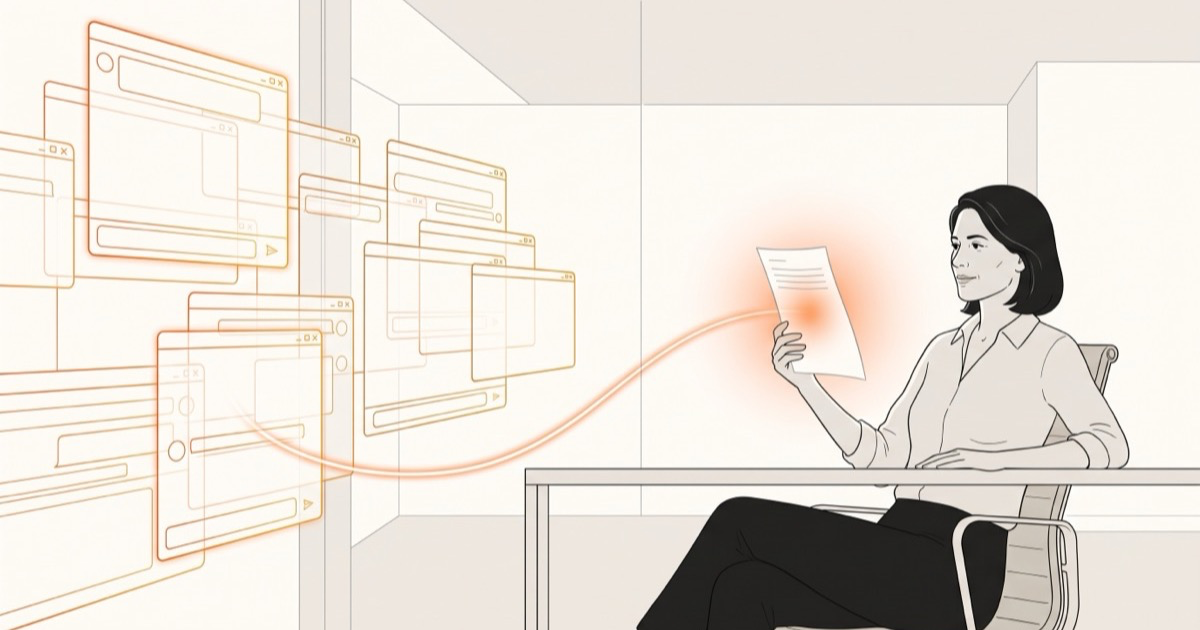
In August xAI released Grok Bot, and three weeks before that Buzz came out of Jack Dorsey's company Block. Both put several AI agents side by side in chat windows, and you write to them the way you write to a colleague. I looked at both and then caught myself thinking about something other than the products. About the sequence they belong to.
The sequence starts with letters. Then came email, and it rebuilt office work like almost nothing else. It did not just add a channel, it added a kind of work. Clearing the inbox. For a lot of people the inbox is still the actual task list, and whatever does not show up there does not happen.
Then came chat. Slack, Teams, meant as the fast thing that fits between the emails. It replaced nothing. Slack never claimed it would: Stewart Butterfield, then CEO, called email the cockroach of the internet and said we had another thirty or forty years of it ahead of us. The press made him the email killer anyway. Butterfield was right.
Since then you answer two kinds of messages instead of one. Microsoft measured how much that is in its own telemetry: 153 Teams messages and 117 emails per person per workday, most of the mail skimmed in under a minute, plus 275 interruptions a day, which is one every two minutes during core hours. Close to half of the people surveyed call their own work chaotic and fragmented. You are supposed to concentrate in whatever is left over.
Now the third kind arrives, and I think something different happens this time. Until now the inbound side limited itself. There were people on the other end who had to write the message and who eventually went home. An agent never goes home, and its output depends only on the compute I pay for. For the first time there is a communication channel with no human speed limit on the sending side.
Herbert Simon settled this in one sentence in 1971: a wealth of information creates a poverty of attention. Over fifty years old, and it describes exactly what is being built right now.
The real limit for me is not the number of messages though. It is that I have to hold the content of all these conversations in my head so that they fit together. With a colleague that works, because they think along, ask back, and remember what was agreed last week. With five agents you are already sorting out who is waiting on you. With twenty, the only place where everything comes together is my head. That is where the design flaw sits, and no better chat interface will fix it.
My first reflex was that we are going to lose threads. I now think that is the wrong worry. Deliberately not holding the threads yourself is exactly what delegation is. A managing director with two hundred people does not know what is happening in every project, and nobody holds it against them. They have standards, and they have people who come and get them when something tips over. Losing threads only hurts because nobody else is holding them.
And that is where chat does not fit. Chat exists so that people can coordinate as peers: everyone reads along, the context sits in the thread, the thread sits in your head, and you pay for it with attention per counterpart. Management runs the other way round. You set a standard and you hear about it when someone misses it. The org chart is the oldest known answer to the problem that more work happens than fits into one head. Daniel McCallum drew the first one in 1855 for the New York and Erie Railroad, because the railway had grown too large to see. A hundred and seventy years of debugging sit in it, and the new agent tools take none of it.
What follows from that is not something I particularly like. Prompting, which everyone is practising as a skill right now, loses value with every model generation, because the models keep getting better at rescuing badly asked questions. What is left is less spectacular and harder: being able to write down how you can tell that a piece of work is good enough.
Most of us never had to. We passed our standard on verbally, by correcting and by whatever was in the room during a meeting anyway. An agent does not read a room. For an agent, only what is written exists. I suspect a lot of companies will find out through agents that they never defined their own standard of quality.
The first automobiles looked like carriages without a horse, because nobody knew what else a car should look like. Brochures were the template for the first websites. New technology borrows the form of the old one and finds its own only once the borrowed form tears. With chat it is tearing now.
I do not know what the right form looks like. I suspect it will look more like reporting than conversation, and be far duller than a stack of chat windows. That is a guess, not a finding. If you are working with several agents right now: how do you keep the overview without reading everything yourself?
Sources
- xAI, Grok Bot, beta launch 11 Aug 2026. unite.ai
- Block, Buzz, launched 21 Jul 2026. TechCrunch
- Microsoft Work Trend Index Special Report, “Breaking down the infinite workday”, 17 Jun 2025. 31,000 knowledge workers across 31 markets. microsoft.com
- Stewart Butterfield on email as the “cockroach of the internet”. Inc.
- Daniel McCallum, first known organizational chart, New York and Erie Railroad, 1855. Slate
- Herbert A. Simon, “Designing Organizations for an Information-Rich World”, 1971. Hapgood