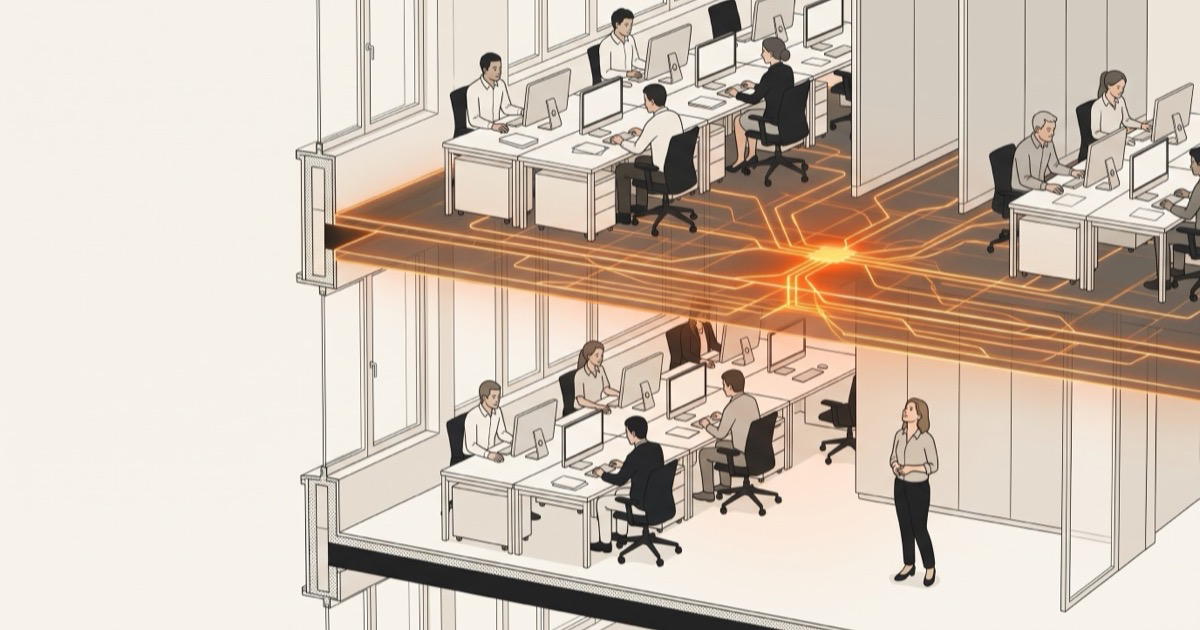
AI doesn't change your company where most people look. The org chart stays, so do the departments. What's new is a layer between the people and the work: an operating layer that carries the company's knowledge. Its core is structured context. And it needs ongoing operation, not a one-off project.
A Tuesday
Take a typical Tuesday. In the morning you read two reports to find a single number. Then you sit in a status meeting where someone presents what one of the reports already said. By evening you have coordinated, but built nothing.
That Tuesday is an architecture problem, not a time management problem.
The two architectures of your company
Your company has two architectures. The documented one lives in the org chart and the process manual. The real one shows in how information flows: through meetings and through the two or three people who know how things work.
The real architecture is the sum of the paths a piece of information takes until it reaches a decision. Almost all of those paths run through people. That is why coordination eats so much leadership time: the architecture has planned you in as the hub, and hubs become bottlenecks.
What AI changes about this architecture
Most companies introduce AI as a tool for individuals: a few ChatGPT licences and a training session. That changes little about the architecture. Information keeps flowing along the same paths, only some people write their emails faster.
The architectural shift begins when the company gets a new layer: the AI operating layer. Think of it as the operating system for AI in your company. It holds the company's knowledge in structured form and takes over work that runs through people today: it gathers information and prepares decisions.
Over the past thirty years, the ERP became the layer for transactions: bookings and payroll runs. No business today would post a booking by shouting it across the office. The AI operating layer takes on the same role for knowledge and coordination. What flows through shout-outs and follow-up questions today will run through a layer that knows the company.
What the layer is made of
The operating layer has two parts: the company memory and the AI system that works on it.
The company memory is structured context. It describes how your business decides and which priorities apply right now, but also the softer things: which customers fit you and what tone you write in. Most of this sits in no system today. It sits in heads. Explicit knowledge like price lists and org charts is the smallest part. The implicit knowledge, meaning how you decide and work, determines whether the system's answers are usable.
With this memory, an AI system can answer questions like "Where do we stand this quarter?" in the context of your own strategy and figures. It can prepare a board meeting or write a decision brief, in the right format and addressed to the people who decide.
Without this memory, the same AI stays a generic tool. That explains why "we already have ChatGPT" so often ends in disappointment: the tool couldn't know the company it was never shown.
Why the model is not the centrepiece
AI models get better and cheaper every month, and they are becoming interchangeable. Your company's context is not. No vendor can bring it along, no competitor can copy it.
That has a practical consequence for your architecture: if you build the layer cleanly, it survives the next model change and the ones after. The memory stays, the model underneath can be swapped. Companies that bet on a single tool instead tie their architecture to one vendor and start over at the next change.
A layer needs operation
Your company is not a static structure. People come and go, priorities shift. Context that is not maintained goes stale, and with it the system's answers. We see it in our own system: two weeks without maintenance, and the answers start to drift.
In our experience, self-built implementations fail exactly here. The build succeeds with some ambition; the maintenance loses out to daily business. After six months the responsibilities in the system no longer match reality and the answers get less precise. Trust drops, and usage dries up.
Work on the operating layer therefore does not end with the build. It needs to be operated like your bookkeeping: on a fixed rhythm, with clear responsibility.
What you can start this week
You need neither a project nor a budget to start. Three exercises show you within a week what an operating layer would look like in your business.
1 — Count the repeat questionsFor one week, note every question you answer even though the answer is documented somewhere, or could be. The list shows you where the architecture has planned you in as the hub. Those are the places an operating layer relieves first.
2 — Trace a decision backTake your last decision brief and write down which sources the information came from: which systems, which people, which follow-up questions. Count the stations. Each one is coordination work a person carries today.
3 — Test the context effectWrite one page on what your company does, what has priority right now, and what a good decision brief looks like for you. Ask an AI tool the same question once with this page and once without. The difference between the two answers is the value of context, in miniature.
If the third exercise convinces you, you have also seen its problem: that one page goes stale. The operating layer is nothing other than that page, extended to the whole company and kept current.
What this means for your Tuesday
The architecture with an operating layer looks unspectacular from the outside. The org chart still hangs on the wall, unchanged. What has changed is the path information takes: it reaches you prepared instead of raw. The number you read two reports for sits in a briefing that knows your strategy. The status meeting gets shorter or disappears, because the layer knows the current state and shares it.
You get back the part of your week the old architecture had booked for coordination.